Initial Data
Problem: The client approached us with unsatisfactory results from previous campaigns. The main issues included:
- Low lead volume combined with a high cost per lead (CPL)
- Inefficient budget allocation, with spend spread across too many small campaigns
- Technical tracking issues: campaigns were optimizing for inaccurate goals (disabled call tracking), which distorted data used by Google AI algorithms
Goal:
- Increase the volume of qualified leads
- Reduce the cost of customer acquisition (CPL)
- Establish accurate and reliable data tracking for campaign optimization
Tasks
- Conduct a full audit and fix conversion tracking setup
- Relaunch and consolidate advertising campaigns
- Reduce CPL (Cost Per Lead) and improve overall advertising efficiency and ROI
Initial Data Analysis
- Target Audience: Women and men aged 25–55 who are interested in laser hair removal, cosmetology, dermatology, and personal care services.
- Competition: High competition in the Lviv market, including private clinics and specialized laser hair removal studios. A key challenge is strong competition for branded traffic.
- Tools: Google Ads (Search, PMax), Google Analytics 4.
Promotion Stages
Stage 1: Technical Audit and Analytics Fixes
We discovered that campaigns were optimizing for “phantom” calls (call tracking was disabled, but the goals were still active). We reconfigured tracking to focus only on real, high-value conversion actions on the website.
Stage 2: Strategy Shift and Budget Consolidation
- Optimized the overall campaign structure
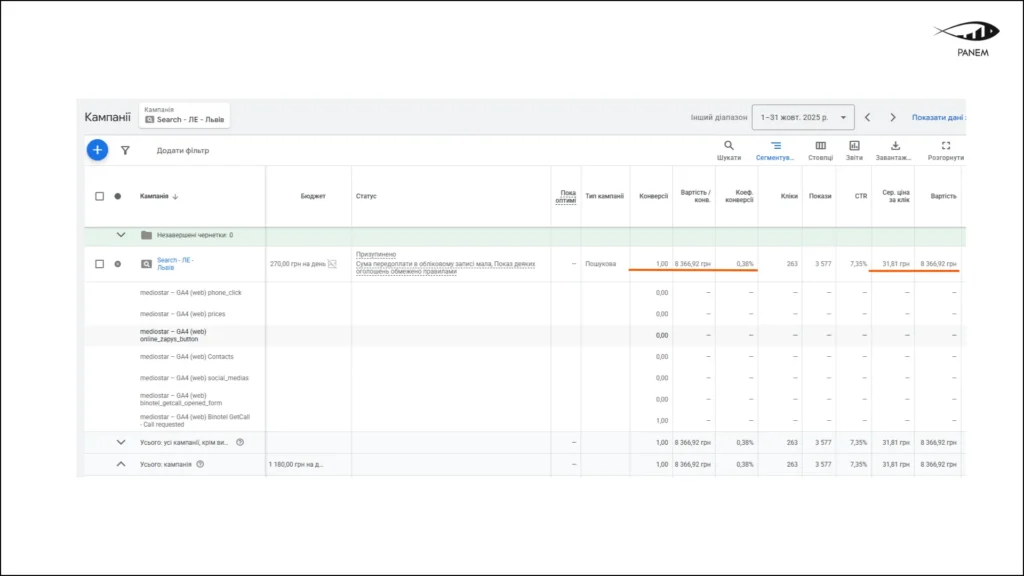
- Instead of running 6 fragmented campaigns with micro-budgets (UAH 130–250), we consolidated them into unified directions
- This allowed the system to exit the learning phase faster and allocate budget more efficiently
Funnel Optimization and Creative Strategy:
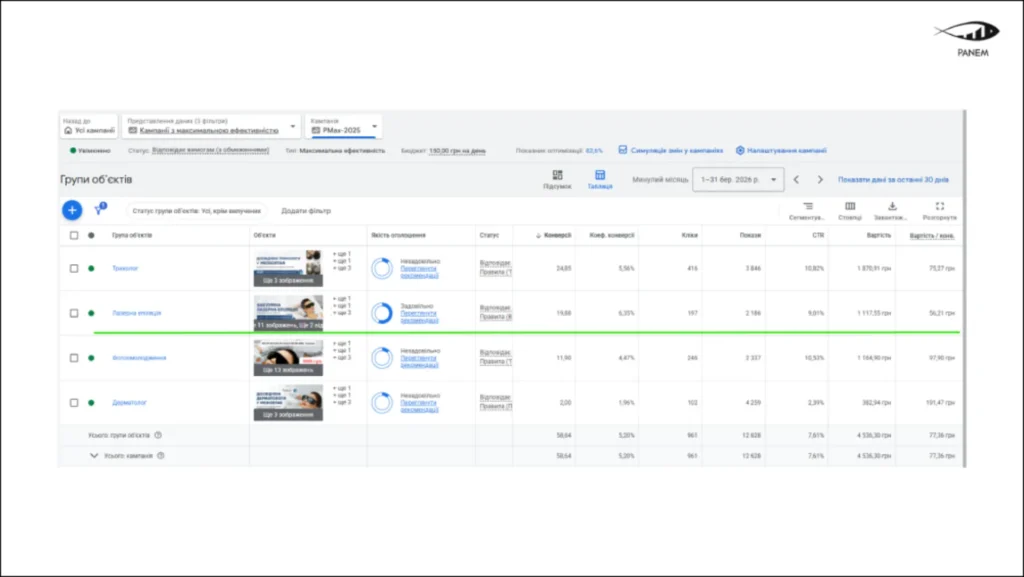
During the analysis, we found that for laser hair removal services, traditional search ads were less effective and more expensive compared to visual formats. Users in this niche respond better to banners and video-based content.
Solution:
- Completely removed laser hair removal from Search campaigns
- Shifted this direction to Performance Max, focusing on high-quality creatives
Result:
This enabled the system to acquire customers through YouTube, Discovery, and Gmail placements, where the cost of acquiring visually-driven audiences was significantly lower.
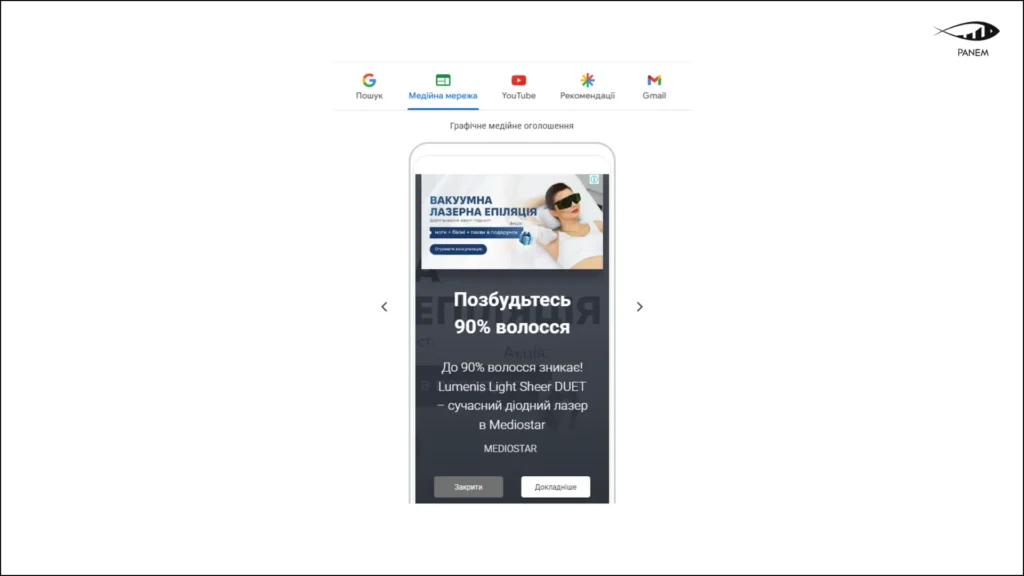
Ad Examples:
Stage 3: Branded Traffic Optimization
We switched branded campaigns to a “Target Impression Share” strategy (90%). This not only secured the top position but also unexpectedly reduced the cost per click.
Stage 4: Scaling with AI and Performance Max
- Implemented AI Max features
- Regularly cleaned and refined search queries
This helped filter out irrelevant traffic in complex niches such as trichology and dermatology, improving overall campaign efficiency.
Results
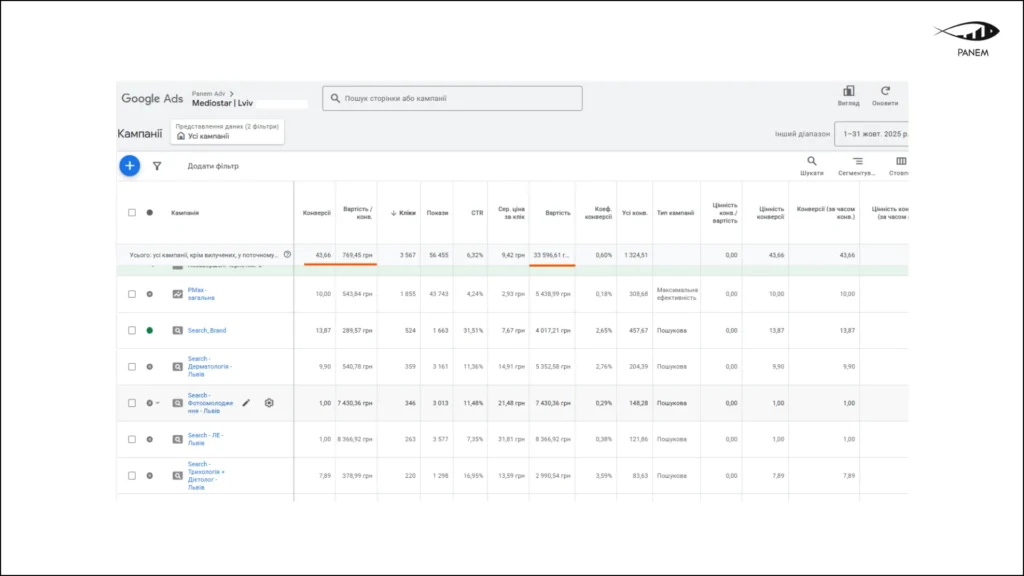
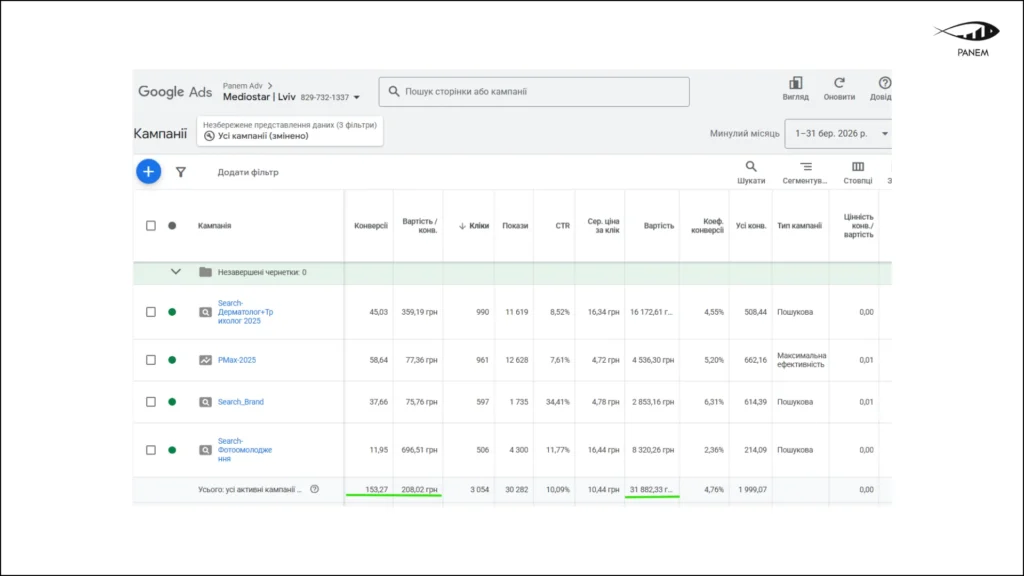
A comparison between the “Before” period (October 2025) and the results achieved during our work (March 2026) shows a significant improvement in advertising efficiency and budget performance.
Key Metrics (October vs March):
- Total Conversions: increased from 43.63 to 153.27 (3.5× growth or +251%)
- Average Cost per Conversion (CPA): decreased from UAH 521.65 to UAH 227.00 (−56% cost reduction per lead)
- Conversion Rate (CR): improved from 1.23% to 1.93%, indicating a substantial increase in traffic quality
- Traffic Volume (Clicks): grew from 3,527 to 7,937 clicks over the same period
- CTR (Click-Through Rate): increased from 6.56% to 9.42% across the account
October 2025 (Baseline):
Campaign performance was limited by inefficient structure, inaccurate tracking, and high acquisition costs, resulting in low overall marketing efficiency.
March 2026
Qualitative Results:
- Scalable growth without quality loss: Despite increased ad spend, the cost of customer acquisition did not rise — instead, it was reduced by half.
- Performance Max stabilization: The campaign began generating significantly cheaper conversions (UAH 77 vs UAH 543), made possible by properly training the algorithm on accurate, real conversion data.
- Niche dominance: By optimizing the bidding strategy in branded campaigns, we outperformed competitors and secured top positions for the clinic’s brand queries while reducing cost per click.
Business Impact
After the collaboration, the clinic gained a stable and predictable flow of patients. By consolidating budgets and fixing analytics, every hryvnia spent on advertising now drives real appointments rather than being wasted on inaccurate data.
Thanks to the updated tracking and strategy, the clinic started generating 3.5× more procedure bookings without increasing the workload of the sales team. This allowed the business to move beyond simply “running ads” and start effectively planning doctors’ schedules weeks in advance.
Conclusion
Consolidation became the key growth driver: in niches with limited budgets, fragmented campaigns reduce the efficiency of Google algorithms’ learning, while combining data and signals allows for faster stabilization and more consistent results.
At the same time, high-quality analytics is the foundation of the entire advertising system. Inaccurate or incomplete data distorts algorithm learning and leads to inefficient budget allocation.
Special attention should also be given to branded campaigns — even if they have strong optimization potential. With the right bidding strategy and proper auction control, it is possible to reduce costs while improving overall performance.
OTHER CASE STUDIES