What Is Website Architecture and Why It Matters for SEO
Website architecture refers to the schematic of how pages relate and how content is organized. A well-structured site shows the path a user can take to find the necessary material and which pages on your website they move through. This is an example of website architecture best practices, helping both users and bots navigate your site.
It’s also important to understand the difference between internal and external structure. Internal is used by bots. For search engines, a site’s architecture is a map they review during indexing. Links help them choose the correct sequence of transitions and study the content on your site.
External is visible to visitors and search engines, which makes it important for usability and SEO. A clear and SEO-friendly website structure positively impacts user experience and ensures full indexing of pages. This allows for improved visibility in search results and website traffic, strengthening the SEO impact of every page on your site.
Types of website architecture: example
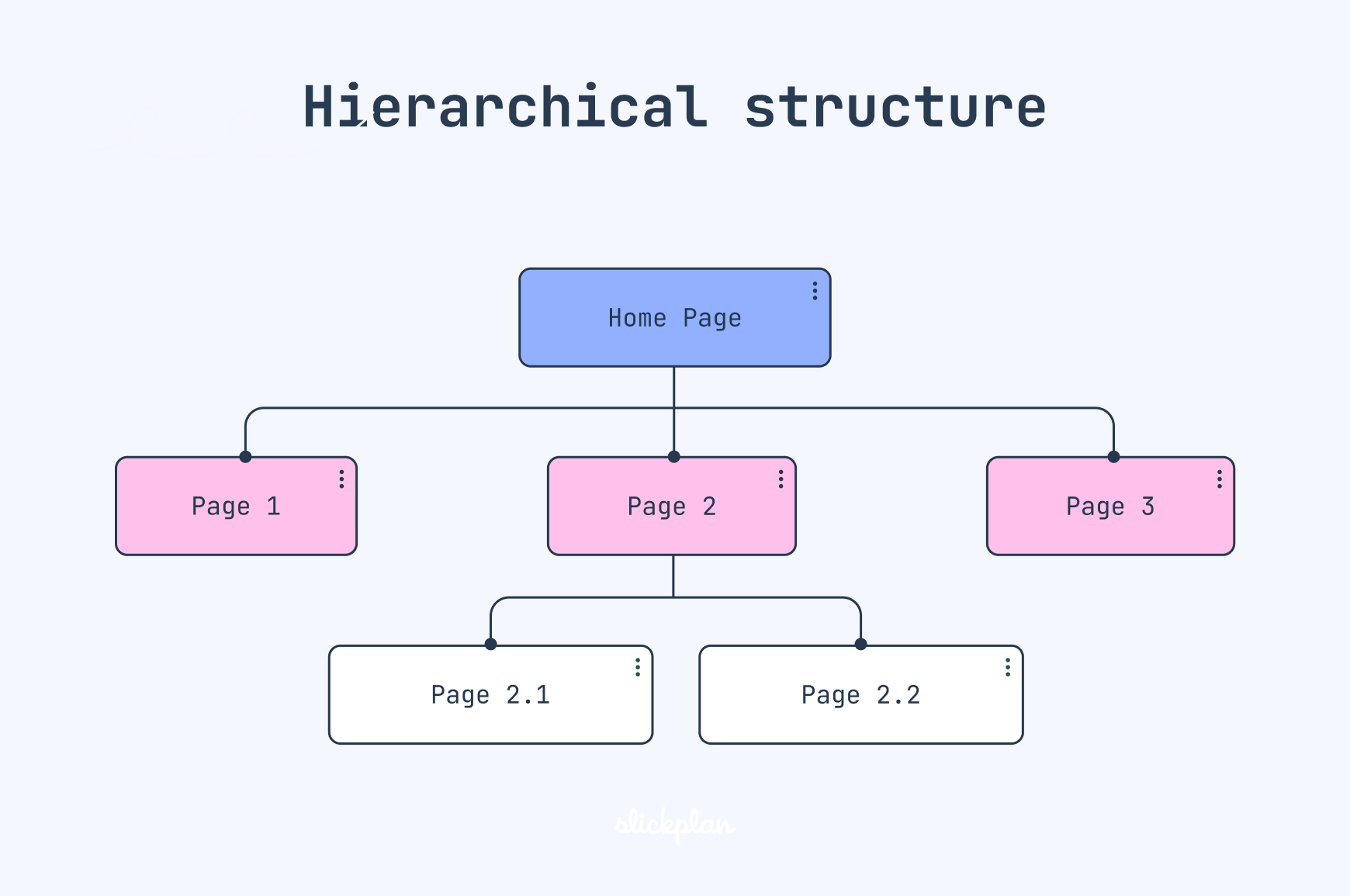
Hierarchical structure or category tree. Suitable for catalogs and high-volume websites. For example, these could be ecommerce sites or marketplaces with dozens of categories and hundreds of subcategories.
Example structure: Homepage — category page — subcategory — product page.
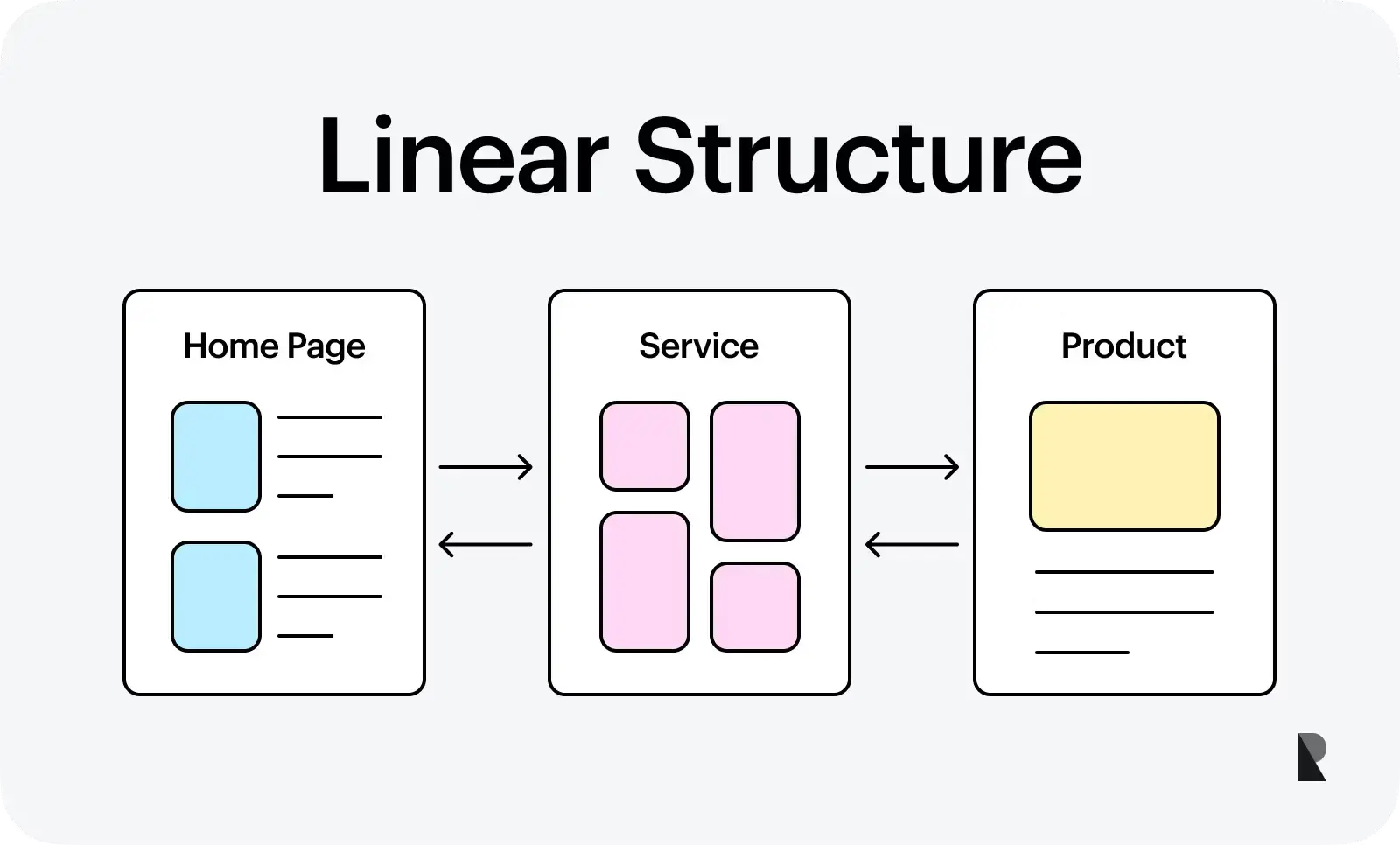
Linear or sequential. The optimal choice for landing pages and sites with a simple user path. A linear structure is often used for corporate pages and “business card” sites that give visitors basic information about the business.
Example structure: Home — product — order — thank you.
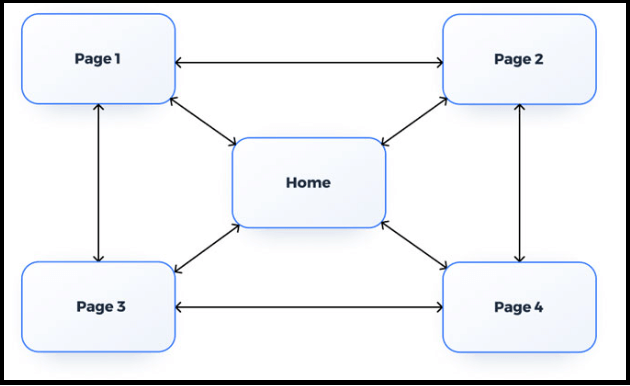
Network models. A complex model used in blogs, media, and portals. Articles are linked with tags or internal linking, allowing fast transitions between many pages within your site.
Example structure: Home — news — article — tag #USA — article 2
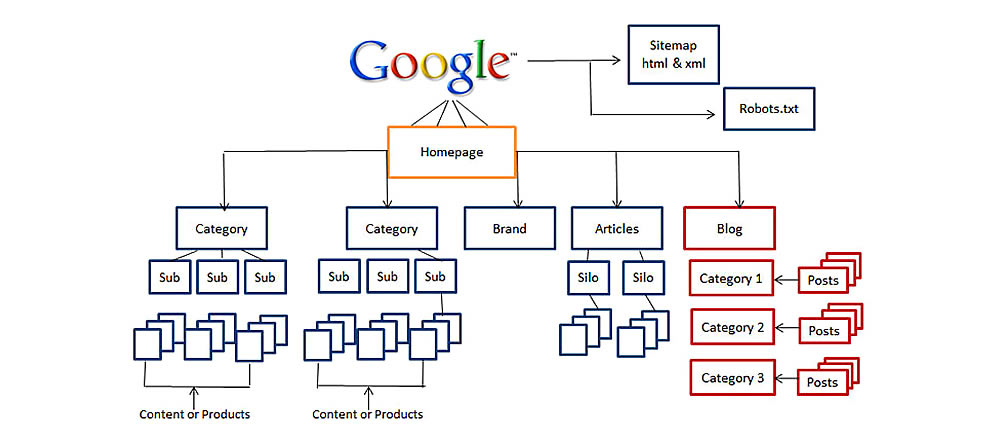
Combined. A complex website structure that combines the principles of a network model and a category tree. A combined structure is used for the largest-scale projects, for example, marketplaces with millions of products or news portals that publish hundreds of articles a day.
Principle of structure: Home — category — product — tag #sale — subcategory — product 2
Requirements for effective site architecture
To understand what kind of website structure will attract traffic and retain visitors, let’s look at the main requirements for it:
- Logical. The user should find the necessary information in 2–3 clicks. For this, it’s important to create a structure with a simple and clear hierarchy.
- Clarity. For good website usability, URLs should be readable words, not sets of symbols. A good example of url structure is site.com/category/subcategory.
- Ease of indexing. A proper site architecture must also be suitable for search bots. This means minimizing the number of pages, removing duplicates, and avoiding chaotic subcategories. A well-organized structure also helps search engines use crawl budget efficiently. When pages are grouped logically and internal linking is clear, bots need fewer resources to crawl the site, which means more pages get indexed and appear in search results.
- Site usability. When designing the structure, one should focus on the user’s way of thinking. It is necessary to think through exactly how they will proceed to conversion.
Why a proper site architecture impacts SEO and business
By adhering to website architecture best practices, you get the following advantages:
- Technical base optimization. Having a clearly designed site architecture in front of you, you understand how much memory it will occupy, what server performance it will need, and which modules will have to be connected. This will help you quickly choose hosting and a CMS without errors.
- Improved financial results. If you create a structure of your website with all requirements in mind from the start, you will spend much less money on SEO, development, and technical work in the future. Moreover, your business gets better visibility in search results and will be more profitable.
- Formation of clear logic. By optimizing internal navigation, you will increase the depth of site exploration by search engines and shorten the path from brand acquaintance to conversion. This improves rankings, user experience, and overall SEO performance.
- Speed and Core Web Vitals optimization. A proper structure helps reduce the site’s loading speed. It also ensures convenience in navigating the main sections for mobile device users.
- Compliance with Google’s algorithms. By paying attention to website architecture at the stage of your site’s creation, you can immediately prepare for planned updates to the search algorithm. Thanks to this, a change in ranking rules will be a plus for you, not a minus.
Basic principles of building a structure with SEO
Website’s architecture is the framework on which search engine optimization efforts rely. For it to work and bring the expected results, SEO specialists must adhere to these principles:
- Priority of the semantic core. When building the structure, each page or category of the site must correspond to a specific cluster of keywords. This allows adapting the content to real search queries.
- Uniqueness. Content and keyword clusters should not be repeated on other pages, so as not to dilute traffic. Of course, certain elements of the site, like the footer and header, can be duplicated. But this should be avoided in the body of the content.
- Minimal depth. The most important pages of the site should be within 2–3 clicks from the main page. Ideally—one or two. This increases the speed of decision-making by visitors and the site’s indexing by search bots.
- Convenient navigation. Each page should be connected to other sections of the site with internal links. The presence of “orphan” pages is a gross technical error that worsens indexing and usability.
- Balance. The external site architecture (menu, categories, navigation) must match the internal (sitemap, internal linking, indexing route). This is a positive signal about the healthy technical state of the resource.
Typical mistakes when creating a site structure
The biggest mistake is starting site promotion in search engines only after its launch. By starting to develop the structure only at this stage, you expose your business to the following risks:
- Additional development costs. An improperly built site structure will mean involving a team of developers and designers in the future. In fact, you will pay for the resource’s development twice.
- Indexing problems. Overly complex and cluttered website structures do not allow search bots to index important pages. As a result, key entry points to your resource may be invisible to users.
- Loss of competitive advantage. Re-optimizing your site’s structure will take a lot of time. While you are bogged down in technical problems, your competitors will have time to take many steps forward.
- Associated costs. Along with development, you will have to pay for an SEO audit, search optimization, and site administration. The longer you delay, the more these costs grow.
Stages of creating a structure during site development
To create a site that will attract traffic and convert it into the company’s business goals, it is necessary to follow this sequence:
- Audit of the market niche and competitors. The first stage of site development is environmental analysis. It is necessary to determine which main categories and subcategories competitors use, and which types of structures work best in this niche. For example, a “business card” site will pair well with a linear site architecture, and an online store with a hierarchical one.
- Collection and clustering of keywords. Formation of the semantic core. At this stage, the semantic core is formed. Key queries are grouped by topic, which allows for obtaining the correct site structure for specific search interests. For example, the queries “buy a tablet” and “buy an iPhone” will be split into different categories.
- Building the site structure. Based on the semantic core, site sections, subcategories, and internal links are identified. For web resources with a large number of pages, visualizations of the site structure are used, which allow specialists to quickly navigate and conduct an express diagnosis.
- Creating a technical specification (brief) for developers and content managers. SEO specialists set clear requirements—how pages will be connected, what URLs will look like, how text and multimedia content blocks will be organized. This ensures the synchronous work of the team during site creation.
- Implementation of technical requirements. Optimizing content loading speed, ensuring mobile responsiveness, and correct site layout using convenient microdata (schema markup).
- Testing and control before launch. An important stage in developing the site structure is ensuring its correct operation. Specialists check indexing, sitemap operation, correctness of redirects, and site usability. This is the final stage where the achievement of goals is confirmed.
Why SEO during development is an investment in future traffic and profit
Involving an SEO team before site development begins allows for forming the basic requirements for the site structure and laying them as the foundation of the technical specification for developers. This gives you the opportunity to optimize every detail for search engine requirements—text, internal navigation, architecture, technical base.
That is, your website doesn’t just inform potential clients about the availability of certain products, but it solves their problems and meets their needs. When they type into search “where to buy a new microwave,” your page appears in the search, collecting clicks and generating sales.
Moreover, optimizing the structure during site creation helps you find common ground with the development team. You will be able to explain what you expect, what solutions you need, and exactly how the site design should look.
The role of the team and SEO integration
Site structure is an important and complex part of the technical base. It must be not just optimized, but ideal. And therefore, competent site development requires combining the efforts of specialists in three areas—web development, search promotion, and design.
The Panem Digital Agency team applies a comprehensive approach. SEO specialists participate in development right from the conceptual planning stage. They set goals for the structure, coordinate the logic of URLs and internal linking, and control the speed and responsiveness of the web resource. This allows for the creation of sites that meet both the requirements of search engines and the expectations of users.
SEO as an investment, not an expense
In business logic, search optimization belongs precisely to the category of investments. By allocating a budget for SEO today, you reduce the costs of site development and support tomorrow, and also get better sales, conversions, and profit figures right from the start.
For example, today you ordered site development for $10,000. At the start, it brings you $1,000 per month, but within six months, you are forced to invest another $5,000 to optimize the structure and catch up with competitors. Thus, at the end of the third year, your total ROI will be: ($36,000 – $15,000) / $15,000 = 140%
A second example—you ordered SEO at the development stage, spending $2,500 before the site launch and $2,500 in the first six months. But right at the beginning, your income was $1,200 per month, and from the second year—$1,500 per month. The ROI in this case will be: ($50,400 – $15,000) / $15,000 = 236%
The difference is palpable. These simplified examples clearly demonstrate that SEO is not just an expense, but an investment in business development that easily pays for itself and makes your company more competitive.
Business results from SEO at the start
By ordering SEO at the moment of planning a new or updated site, you get a host of advantages from the very first day of the web resource’s operation. It achieves positive results in a highly competitive environment, creates a positive image for your business, and increases the return on investment.
Proper design also immediately prepares the site for future scaling. By adding new pages on your website, sections, and categories, you quickly promote them in the search results and spend minimal effort to achieve the desired goals.