Medical advertising is one of the most sensitive categories in Google Ads. Due to strict policies, even legal campaigns often face restrictions or blocking, resulting in lost traffic and inquiries.
In this case study, we share practical experience working with a medical clinic that faced systematic restrictions from Google. We will show the key reasons for ad blocks, common mistakes, and the solutions that allowed us to stabilize the campaigns and ensure a constant flow of inquiries.
The medical niche requires flexibility, testing, and adaptation. While there is no universal solution to avoid blocks, effective strategies can help reduce risks and maintain ad stability. Our approach focuses on adhering to Google’s policies, properly structuring ads, correctly setting up landing pages, and systematically analyzing performance.
Campaign Steps:
- Risk Analysis and Google Policies Review
Before starting, we thoroughly analyzed Google’s policies regarding medical topics, including:- Personalized health-related advertising
- Restrictions on promoting sensitive categories (e.g., gynecology, urology, adenoma treatment, ultrasound, etc.)
- Potential triggers that could cause blocks or reduced campaign effectiveness.
This allowed us to anticipate possible reasons for ad rejections and avoid them during the preparation phase.
- Working with Types of Restrictions
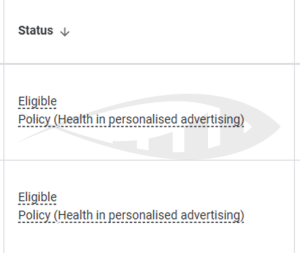
We audited the campaign’s ad statuses and found that the “personalized ad: health” tag does not critically impact reach or performance.
Typically, this status appears when viewing search ads, and it is one of the safest statuses. Launching medical campaigns does not affect ad performance.
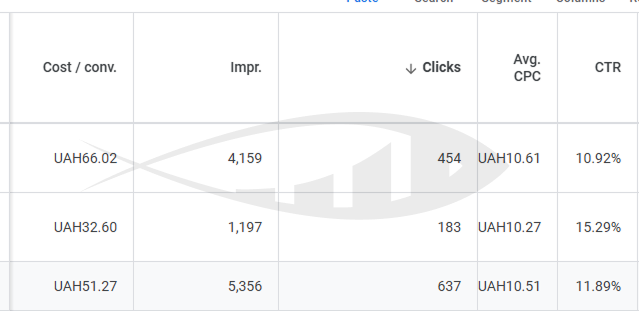
All ads in the campaign had the “personalized ad: health” status, but this did not prevent achieving stable and effective performance with high conversion rates.
At the same time:
- For gynecological services, we excluded triggering terms like “contraception” and “testing”. These were replaced with neutral terms that do not trigger blocks.
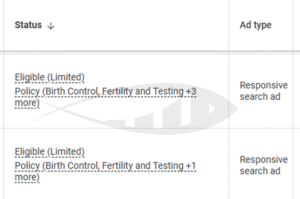
- Age restrictions were applied for certain services (e.g., adenoma treatment). For optimal performance, it is recommended to implement age restrictions for ad display and test audience segments to exclude groups that could potentially lead to ad blocking. Although this may reduce CTR and increase conversion costs, professional optimization ensures stable and effective results.
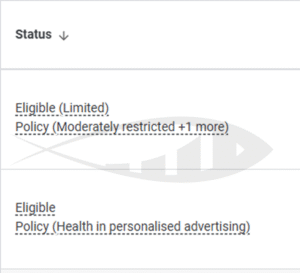
These steps allowed us to reduce the number of ads marked as “Limited by policy” or “Rejected.”
Even after removing potentially problematic words, ads might still be restricted or rejected. In such cases, we recommend temporarily changing the URL to a doctor’s page or creating an updated landing page with fixes for ad redirection.
How to Avoid Medical Ad Blockage in Google Ads:
- Get Google Ads Certification for Medical Advertising:
For advertising medical topics in some countries (including the USA, Canada, and EU countries), Google Certification for Healthcare Advertising is required.
To apply:
- Visit the certification form: [Google Ads Certification Request]
- Select the “Healthcare and Medicines” category.
- Provide your website URL, display region, and a brief service description.
- Wait for confirmation (usually within 2 to 10 working days).
Without certification, even fully legal medical services ads may be blocked.
- Ensure Your Website Complies with Google Policies:
- Add “About the Clinic/Doctor” pages with licenses, certificates, and registration data.
- Include a disclaimer: “The information on this site is not medical advice.”
- Avoid absolute promises like “100% result,” “guarantee,” or “the best.”
- Adapt Creatives to Comply with Policy:
In this case, creatives were rewritten to align with platform policies and marketing effectiveness. We transformed messages to preserve user value without violating Google’s rules:
- Original: “100% result” → Transformed: “Individual approach to each patient.”
- Original: “Professional diagnostics” → Transformed: “Ultrasound with a 10% discount.”
This adaptation enabled the ads to pass moderation without being blocked, continuing to generate inquiries.
- Use Specialized Campaign Categories:
If search ads are blocked, create campaigns in Display or Performance Max with the “health” theme, where more precise audience targeting is available.
It’s recommended to add custom segments like “healthcare services,” “mental health,” and “plastic surgery.”
This screenshot shows targeted Google Ads audience signals — high-intent search topics for ultrasound services in Lviv.
By providing these specific keywords, we guide Google Ads to focus on users actively looking for such services, boosting relevance, lead quality, and campaign ROI.
- Appeal If Blocked:
- Sign in to Google Ads → Policies
- Review the reason for the block
- Edit your ad or credit
- Click “Appeal” or “Request Reconsideration.”
- Add a clear explanation in English
- Expect a response within 1-3 business days
Campaign Results for the Private Clinic:
By properly distributing budgets and optimizing for each service, we achieved a high ROI.
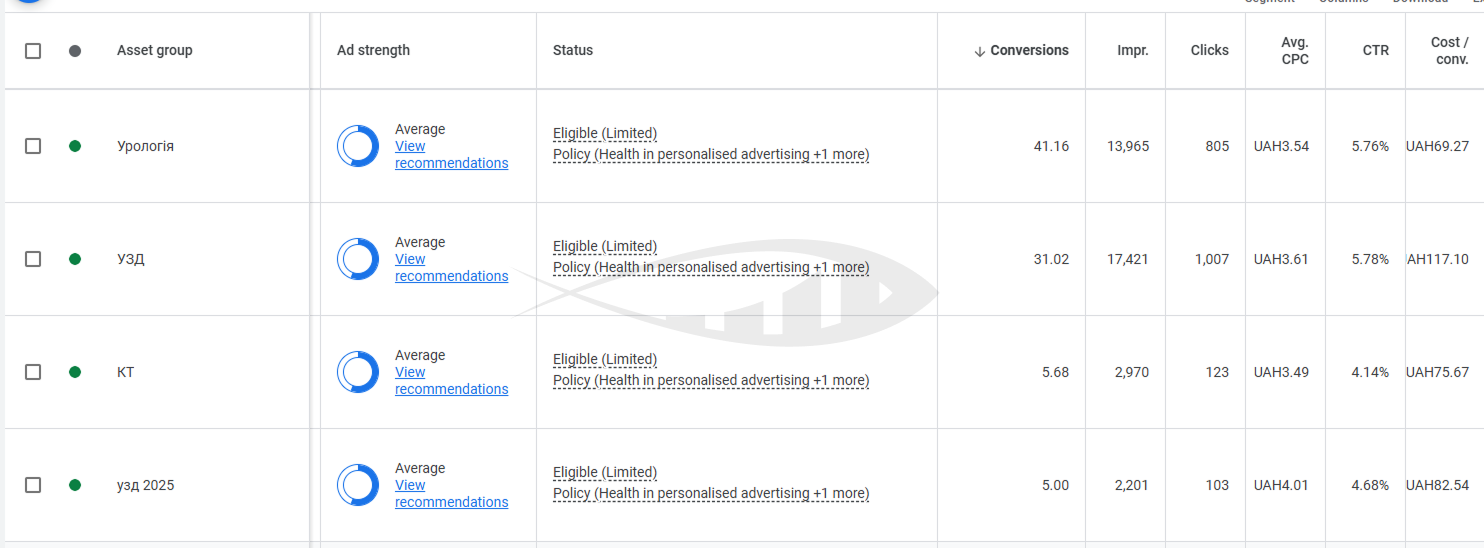
The best results were achieved with the “Ultrasound” group:
- Conversion rate: 22.80%
- Cost per click: 0.98 UAH
- Clicks: 4151
- Impressions: over 83k
The most expensive click was for “Urology,” but it still had a good conversion rate of 14.82%.
Overall, the ROI for the campaign was positive, with the client receiving a high volume of leads at a very low cost. The campaign fully complied with medical advertising requirements. Successful service segmentation allowed precise optimization of each group.
Next Steps:
- Launch new campaigns for individual services
- Integrate additional advertising channels
- Further automation via Google Analytics
Conclusions:
Advertising medical services on Google Ads is entirely feasible but requires a careful, professional approach and strict adherence to the platform’s advertising policies. To avoid blocks and ensure stable campaign performance, it’s important to use neutral and cautious language, create legal and compliant landing pages, obtain Google certification when necessary, and carefully review content for potentially triggering phrases or prohibited topics. This approach enables successful medical advertising with minimal risks and maximum return.

OTHER CASE STUDIES