Unlike SEO for informational content, e-commerce SEO goes for purchase intent sales — those searches that users conduct in order to buy something. This method also includes enhancing product and category pages, site structure, and user experience to acquire high-intent buyers who are ready to make a purchase.
The significance of SEO in modern competitive online environments cannot be ignored. For e-commerce websites, the organic search channel remains the largest expected source of traffic, representing nearly 51% of all visits.
Without a doubt, it’s the most potent channel for cost-effective, sustainable growth. Mastering the SEO for eCommerce sites means setting up an automated sales system that operates 24 hours a day, 7 days a week, continually driving demand and qualified traffic for the online store.
Why Does SEO Matter for eCommerce Businesses?
What is SEO for eCommerce? In eCommerce, visibility is everything. Most of your customers will search Google to find specific products and you have to use the right keywords to ensure that they get to you.
Let’s explore the compelling reasons why implementing SEO for eCommerce is not just beneficial but absolutely essential for modern online retailers.
Drives High-Intent Organic Traffic to Your Site
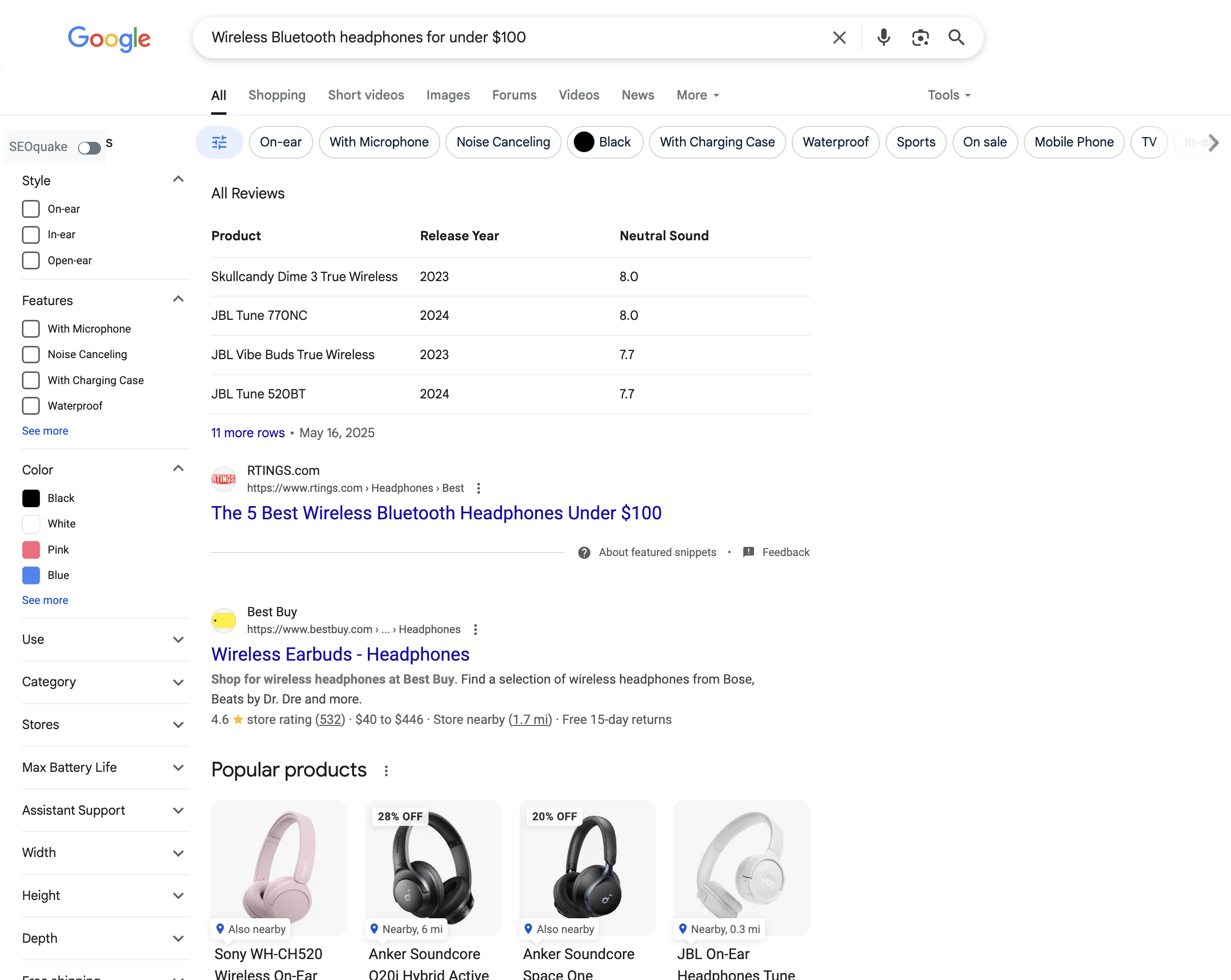
“Wireless Bluetooth headphones for under $100″ is a clear purchase intent query. People do not search for product eCommerce web pages or catalogs out of obligation. Rather, they do that with definite plans to buy something.
From the sales data, we know that 35% of eCommerce orders stem from organic traffic. This strongly supports the need for search presence since sales revenue depends on it.
Marketing and advertising tactics have changed drastically. 51% of the population finds out about new products and companies online. If you do not employ the best SEO practices, you are losing out on potential customers.
Reduces Customer Acquisition Costs
The CACs that were created through paid ads are always higher than those generated through organic channels. Whether you are running a B2B SaaS company or an eCommerce business, the statistics hold true.
While paid ads do have their advantages, serving as an instant source of traffic, they need to be supplemented constantly. SEO is a long-term investment as it decreases reliance on paid ads and incurs lower expenses over time. However, SEO is a cost-effective method to get more conversions, too.
SEO works best over time. Businesses that spend money on ads can drastically reduce spending with effective SEO strategies. Additionally, the use of well-optimized pages amplifies the effect as pages continue working long after the SEO work is done.
Improves Visibility Across the Funnel
Today’s customers require way more than a single piece of information before heading to buy something as they conduct thorough research by evaluating various platforms.
The goal of eCommerce SEO practice involves not only making the final sale but enabling marketing-driven conversions and recapturing customers at any step within the consideration and purchase cycle. Even from the first keyword suggestions which happen months before the actual purchase (like “best running shoes for beginners”) to decision making (“Nike Air Max 270 size 9 free shipping”).
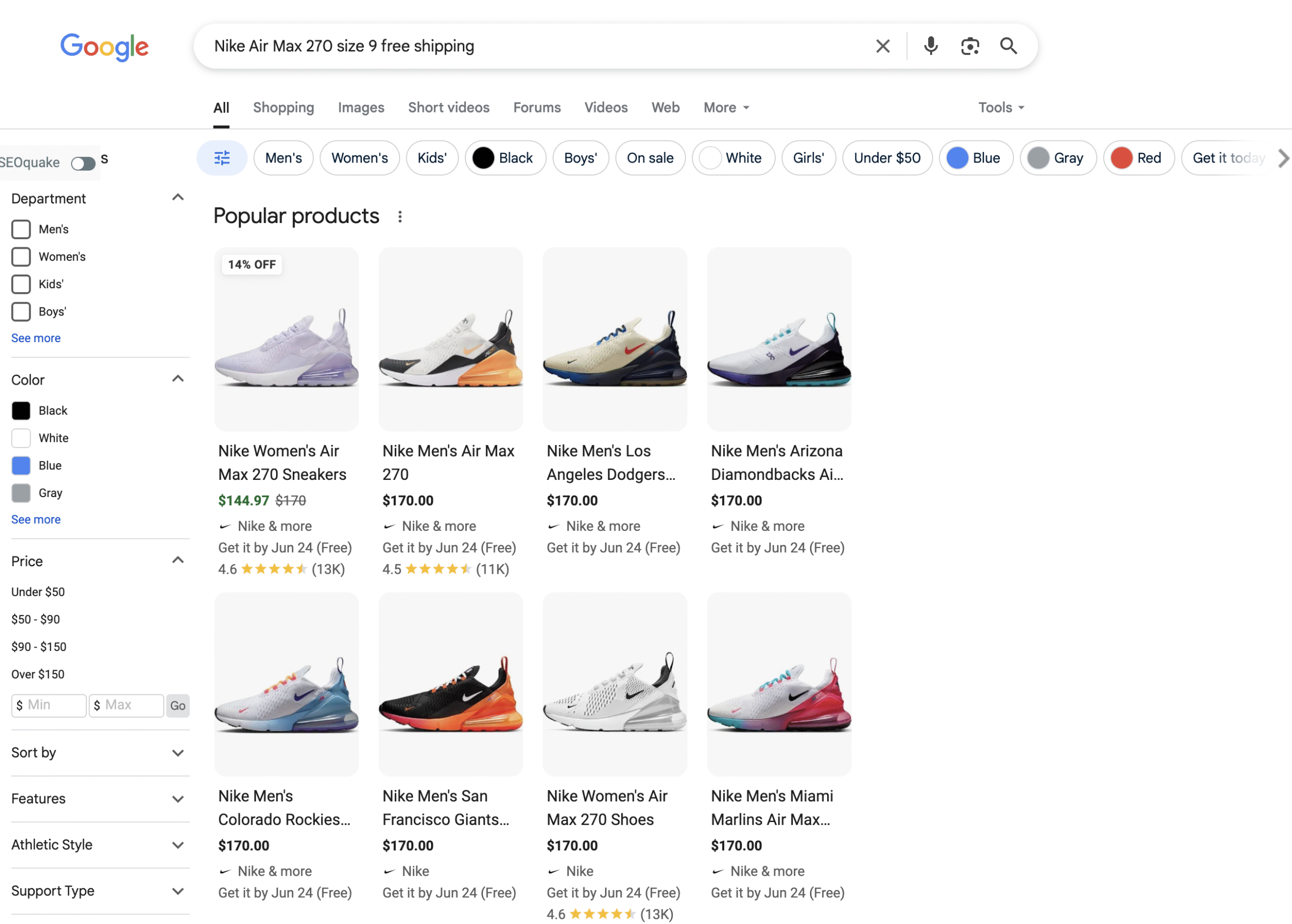
SEO strategies also include posting and maintaining blogs, creating buying guides, writing comparison articles, and designing a structured FAQ page that assists customers in answering their queries within the decision-making cycle.
Following this holistic practice will ensure your eCommerce platforms will always stay relevant and your products visible, no matter what phase customers are in their buying journey.
Builds Trust and Credibility
Is there any way you would trust a business that you can’t find anywhere in the search results for the products they claim to offer?
Customers perceive search ranking as an indication of a business’s credibility and authority in the market. In fact, the top three organic search results on Google received 68.7% of all clicks. This means that gaining a good rank will aid the customer’s perception of your business as trustworthy and established.
SEO strategies that concentrate on valuable content creation and improving website UX are going to build trust with search engines and customers alike.
When your eCommerce site delivers seamless shopping experiences, shoppers will gain confidence in your brand and loyalty as well. And increasing trust leads to higher conversion rates.
Enhances User Experience
Users get the best experience from a website when it is fully responsive and functionally systematic. For that reason, UX optimization is an important part of any SEO effort.
Winning the user’s experience is more than just effective advertisement. It is an understanding of how to do eCommerce SEO in the sense that your ranking and user experience are one entity.
An immense improvement in conversion rates with clear product descriptions, better navigation, mobile responsiveness, and faster loading times is a certainty with better search ranking as a cherry on top.
Supports Long-Term, Sustainable Growth
Unlike paid advertising, which stops delivering results the moment you stop paying, SEO results build momentum over time. Technical SEO improvements, optimized product and category pages, and a strong content strategy create lasting foundations for growth that continue generating returns for years.
The compound effect of SEO means that businesses implementing eCommerce SEO strategies today will enjoy increasingly better results over time. While competitors chase expensive ad placements, companies with strong SEO performance capture organic market share with significantly lower ongoing costs.

How to Implement Effective SEO Strategies for eCommerce
Now that we understand why SEO for eCommerce matters, let’s shift our focus to how to improve SEO on an eCommerce platform. Success requires a systematic approach that combines the technical aspects of eCommerce and the customer-oriented aspects.
- The foundation starts with comprehensive keyword research. Understanding how to SEO for eCommerce begins with identifying the exact terms your customers use when searching for your products. This goes beyond obvious product names to include problem-solving searches, comparison queries, and brand-specific terms that drive qualified traffic to your website.
- On-page SEO for eCommerce focuses on products that need to be marketed individually, thus requiring attention to their titles, descriptions, images, or even data markup. Pages with schema markup experience a 40% higher CTR in comparison to unmarked pages. Therefore, the proper execution of technical strategies is essential for visibility and click rates.
- Technical SEO includes site structure, user experience, speed, and mobile friendliness, among others. Many eCommerce websites today lack functional links which highlights the inability of the business to maintain proper technical audits and upkeep for their sites. Knowing how to improve the SEO of an eCommerce website requires focusing on the aforementioned elements because they prevent search engines from crawling, indexing, and subsequently ranking your content.
- Local SEO is critical for businesses with a storefront or those catering to specific regions. Almost half of searches on Google have local intent, with more than half of users performing a local search will visit a store located within a 5-mile radius. Creating and optimizing your eCommerce store’s Google My Business Profile and business profiles helps ensure local customers can access your store.
- Content Marketing via blog posts, buying guides, and other educational material serves to bolster your marketing strategy as they target informational keywords related to your transactional pages. Prioritizing content marketing has proven to increase conversion rates sixfold for eCommerce businesses, demonstrating the strength that a well-defined content strategy can have on eCommerce success.
Popular eCommerce Platforms (and How They Affect SEO)
Determining which eCommerce platform is best for SEO involves analyzing how each platform manages technical optimization, customizations, SEO features, and more. There are various pros and cons and each platform has its own distinct value which can influence your website’s optimization goals.
Shopify
Shopify offers standard SEO functionalities natively, such as editable title tags, meta descriptions, URL formats, and more. Additionally, the platform automatically deals with the technical elements of SSL certificates, page speed, and mobile-friendly design.
However, learning how to do strategic SEO for your eCommerce website Shopify requires a thorough consideration of the platform. Limitations include restrictive URL formats for product variants and minimal control over site hierarchy.
The platform’s app ecosystem offers numerous SEO tool options for advanced optimization, from structured data markup to advanced analytics. While Shopify simplifies many technical aspects, serious eCommerce marketing efforts may require additional apps or custom development to achieve optimal SEO performance.
Magento
Magento allows businesses complete flexibility over their SEO optimization through its deep customization options. It comes with a bunch of advanced features such as layered navigation, URL handling, and category and product page management, among others. However, this level of flexibility comes at a price in the form of implementation complexity.
Magento SEO services are supported natively by the platform, making it suitable for businesses with complex product catalogs and advanced SEO requirements. Its capability to manage vast inventories and complicated product relationships makes it ideal for enterprises that know how to improve the SEO of an eCommerce website on a large scale.
OpenCart
OpenCart strikes a great balance between ease of use and customization flexibility. It also provides basic SEO capabilities like user-friendly URLs, meta descriptions, and sitemap support. While it might not be as robust as Magento or as intuitive as Shopify, nearly all eCommerce companies should be able to effectively leverage OpenCart for their SEO tasks.
Its nature as an open-source platform allows for bespoke modifications that can fill particular gaps in SEO optimization tailored to specific business needs. In many cases, achieving targeted results requires extra extensions or custom development work.
WooCommerce
As with all eCommerce websites, online stores built with WooCommerce gain from having their products indexed by search engines. Since these stores run on the WordPress CMS, WooCommerce benefits from the SEO capabilities of its parent platform.
WordPress offers a rich ecosystem of SEO-related tools and plugins such as Yoast SEO or RankMath. Plus, understanding how to SEO an eCommerce website working on WooCommerce requires leveraging WordPress’s content management system for blog marketing and an elaborate content strategy.
The platform offers reasonable control over the texts of products, descriptions of categories, and a number of other technical SEO elements. You also need to focus on using the right hosting and doing the right optimization for performance, as without them, WooCommerce sites can be sluggish.
Common SEO Mistakes in eCommerce and How to Avoid Them
Recognizing the importance of SEO for eCommerce, online businesses often fail to leverage it to its fullest potential due to critical errors. However, by understanding these common mistakes, you will be able to develop more impactful strategies and steer clear of wasting valuable time and resources.
Neglecting Product Description and Meta Optimization
The case of ignoring product description optimization stands out the most. Averaging 39 characters, eCommerce page titles fall significantly short of the industry standard of 50-60 characters. A lot of firms either use the manufacturer’s description or write very little content, missing opportunities to incorporate relevant keywords and add value to the customers and search engines.
Ignoring Critical Technical SEO Issues
Ignoring technical SEO issues creates barriers that prevent search engines from properly crawling and indexing your site. The average eCommerce meta description was 96 characters long, again below the industry standard of between 150 and 160 characters. These seemingly small details significantly impact your ability to improve your online visibility and attract qualified traffic.
Treating SEO as a One-Time Setup
Another critical error involves treating SEO matters for eCommerce as a one-time setup rather than an ongoing process. SEO is the process of continuous improvement, monitoring, and adaptation to changing search algorithms and customer behaviors. Businesses that succeed in understanding overall SEO require consistent attention and regular updates.
Failing to Optimize for Mobile Users
Many eCommerce websites also fail to optimize for mobile users, despite mobile commerce representing a significant portion of online sales. Understanding how to improve your eCommerce SEO means prioritizing mobile experience, as search engines now use mobile-first indexing for ranking decisions.

Need Help with Your eCommerce SEO? Work with Experts Who Get Results
Mastering how to do SEO for an eCommerce site takes experience, time, and constant effort. Even though learning the basics is important, most businesses would greatly benefit from working with an SEO expert who focuses on eCommerce optimization.
What is SEO in eCommerce and why does it matter? SEO matters a lot since it relates directly to your profitability, and mismanaging it could mean losing thousands of customers and revenue. SEO professionals have extensive experience with algorithm changes, technical optimization, and other relevant strat
What to Look for in an SEO Partner
The right SEO professional understands that SEO is important for eCommerce and goes beyond just optimizing your website to rank high — it’s about creating sustainable growth engines that grow your business while reducing dependency on paid advertising. They know how to improve eCommerce SEO through comprehensive strategies that address technical foundations, content optimization, and user experience improvements.
When evaluating potential partners, look for agencies that understand traffic to your eCommerce needs going beyond vanity metrics. The best SEO services focus on driving qualified traffic to your site that converts into actual sales and long-term customer relationships.
Proven Results and Strategic Approach
Consider working with experts who can demonstrate the clear benefits of SEO through case studies and measurable results. They should understand that SEO matters for eCommerce means balancing immediate needs with long-term effective SEO strategy, ensuring your investment delivers both quick wins and sustainable growth.
At Panem Agency, we specialize in comprehensive SEO strategies that drive real business results. Our eCommerce SEO services are designed specifically for online retailers who want to dominate their market through organic search visibility.
Making the Investment Decision
Remember, creating comprehensive optimization strategies and finding out how to do SEO for an eCommerce website takes time and expertise. While you can implement some basic improvements on your own, partnering with experienced professionals often provides the fastest path to significant results and helps you avoid costly mistakes that could set back your progress for months.
Our team offers thorough SEO audits that identify exactly what’s holding your eCommerce site back and provide actionable roadmaps for improvement.
The question isn’t whether you need SEO for your eCommerce business — it’s whether you’re ready to invest in the strategies and expertise necessary to capture your share of the billions of searches happening every day.
With the right approach and professional guidance, your eCommerce store can achieve the visibility, traffic, and sales growth that transform your business from surviving to thriving in the competitive online marketplace.
SEO on your website works best when implemented as part of a comprehensive, powerful digital marketing strategy. Whether you choose to handle optimization in-house or work with experts, the key is getting started and maintaining consistent effort toward a website to rank higher in search results, where your customers are actively looking for the products you sell.